Magic Box: Let Us Out
Medium: Magic box (box, mirrors, Sumi ink on mounted rice paper)
Dimensions: 120 × 180 × 23 cm
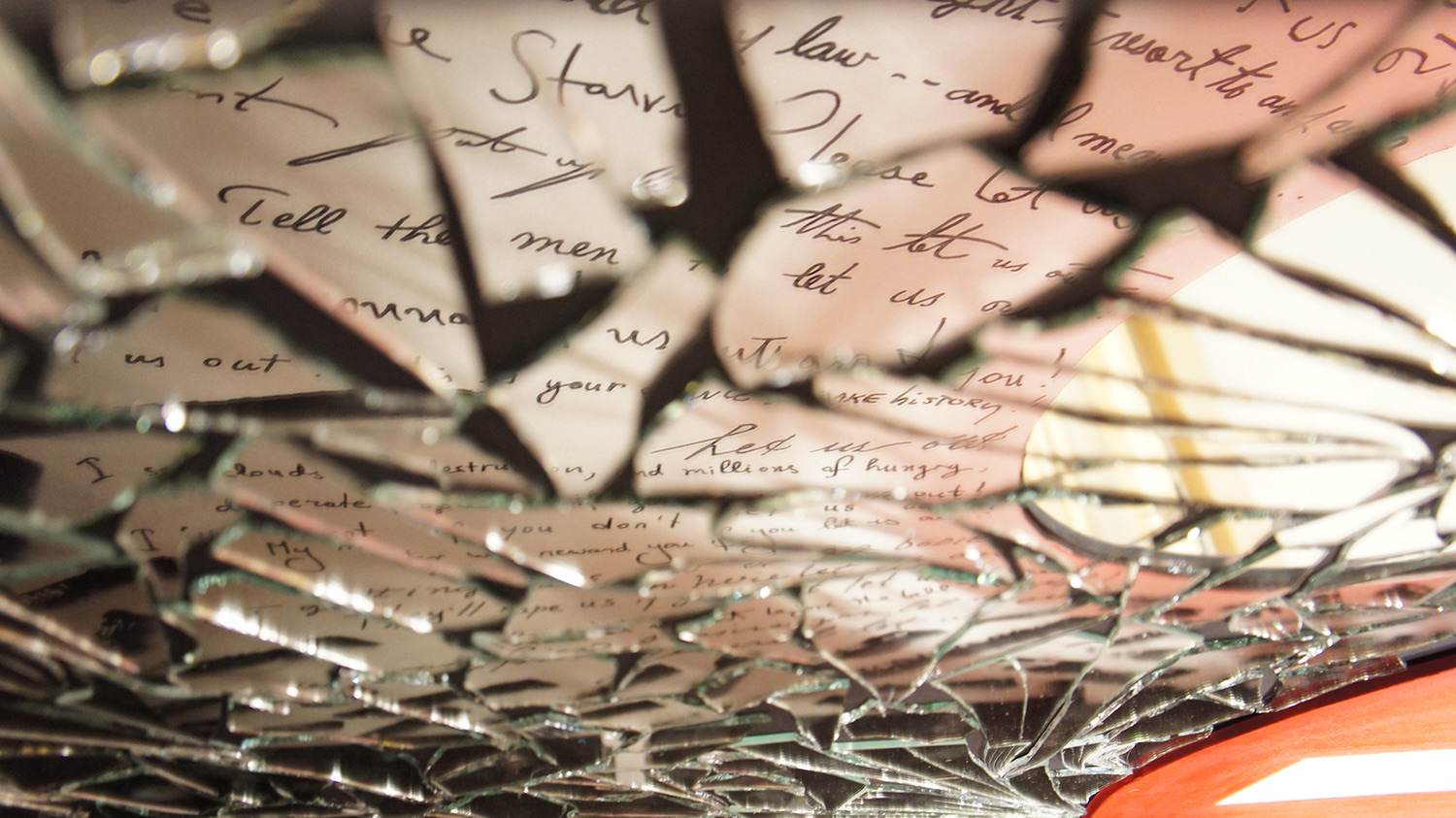
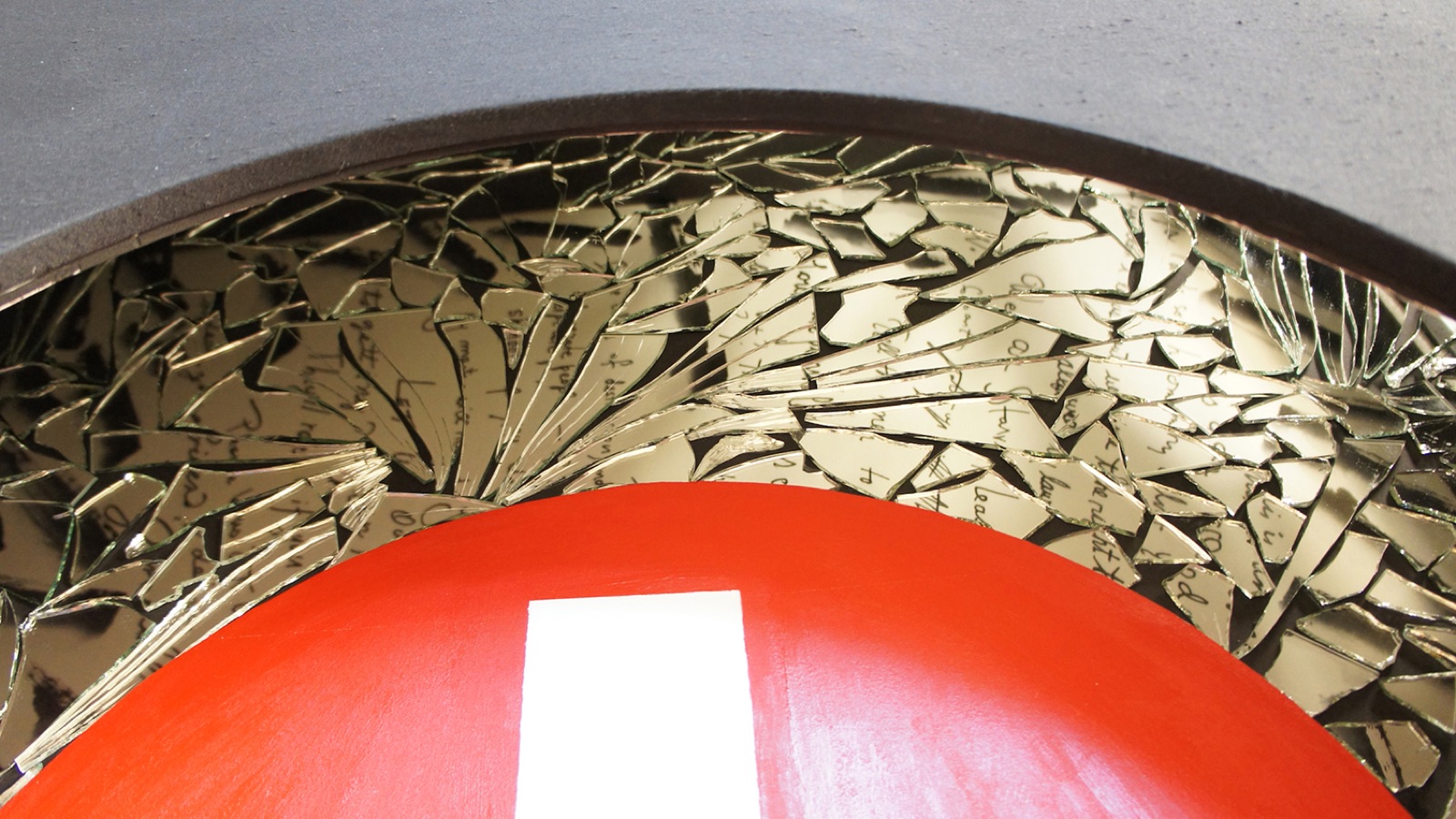
Let Us Out! is a Magic Box. The Magic Boxes are a new art form developed by Drue Kataoka Studios in which, for the first time in the history of painting, the artwork turns its back on the viewer. The painting faces away, inside a mirror-lined box, reachable only through a single circular aperture. Peer in, and you discover that the painting exists for you solely as reflection: scattered across a field of mirror fragments, in pieces, at angles, doubled and interrupted. Shift your body and one passage surfaces while another slips away; what was hidden emerges, what was vivid dissolves. Revelation and concealment arrive in the same gesture. No vantage point, no accumulation of vantage points, will ever yield the whole. The whole takes shape elsewhere — in your memory, glimpse stitched to glimpse. This is how we come to know anything, or anyone — in fragments, across gaps.
The Concept
“Let Us Out!” is a Magic Box about the one-way street of human existence. Inside it is a cacophony of voices in pain — hoping, praying, cajoling, pleading to be let out, some even threatening — each of them grasping the reality of their confinement. Very few, if any, will ever get out. And we, the viewers, are not allowed in: the aperture itself is a No Entry sign. All we can do is lean close and peer through — and in the shattered mirror where their words become legible, catch ourselves. Not our reflection: our recognition. Confinement, in one form or another, is part of the human condition — and somewhere among those hands, the plea becomes our own.
The Voices
Around the No Entry sign are painted more than fifty statements, every one containing the phrase “let us out” — desperate or jubilant, argumentative or threatening. Each is my precise reproduction of a real person’s handwriting, living or dead, famous or not — painted in exact reverse and scaled more than ten times larger, so the words can be read only in the mirror fragments. The trapped voices reach you the way the painting itself does: in pieces, by reflection.
I curated the participation of people from all walks of life — businessmen, engineers, a cheerleader, a lawyer, a prisoner, an Afghan war veteran, a gynecologist, a football player — each of whom shared, in their own hand, the phrase I assigned them. Alongside them I reproduced the handwriting of the dead: Freud, Einstein, Princess Diana, Thomas Mann, Pushkin (from his letters, in French), George Washington, Rousseau — and a sadistic Jamaican slave owner.
Authenticity and forgery, document and fiction, expectation and its undoing — good and evil, genius and mediocrity — the box holds them all without ranking them, and leaves them to you as open questions. Inside, every voice, whoever it belonged to, is making the same plea.